Why Army Values Exist
An evolutionary, psychological, and civic argument for a professional warrior code

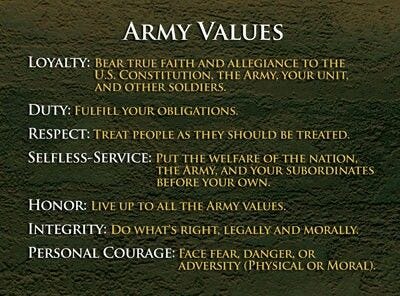
A fighting force is held together not by equipment, doctrine, or even leadership alone, but by something older and deeper: a moral architecture that disciplines instinct, shapes emotion, channels aggression, and binds human beings into a coordinated, trustworthy, and effective coalition under conditions where fear and violence surge, and where failure may be fatal. The United States Army expresses this architecture through the Army Values printed in its manuals and taught in its schools. But those words, recited in classrooms and emblazoned across posters, are only shadows of the thing itself. Before we can talk about what the Army Values mean, we must first confront what a value actually is.
Values are not abstractions floating above behavior. They are the things we actually place value on, the things an institution truly rewards and reinforces. They represent what we elevate, admire, and define as worthy of imitation, and they show in our actions more than our words. When the Army publishes a set of “Values,” it is not describing soldiers as they are but declaring what they must become if the Army is to function as a professional fighting force and if its members are to return from war capable of rejoining the society they serve. In that sense, Army Values are not descriptive virtues but aspirational commitments, pointing toward the kind of human beings the Army is attempting to form.
This series exists to restore depth to these concepts, to move them out of the realm of memorized acronyms and into the realm of serious reflection. Soldiers know the words. Leaders repeat the slogans. Evaluations cite them mechanically. But values that are not considered, studied, debated, and internalized do not shape behavior when crisis arrives. They become background noise. And in the moment when uncertainty, fear, lethality, and responsibility collide, background noise vanishes. Only internalized meaning survives.
The Army has learned this lesson, often painfully. The catastrophic ambush of the 507th Maintenance Company during the opening stages of the Iraq War revealed something the institution had forgotten: soldiers do not rise to the occasion; they fall to the level of their training and identity. Years of peacetime assumptions had shaped expectations that were incompatible with the demands of modern decentralized warfare. Support soldiers believed themselves exempt from close combat. Units assumed lethal responsibility belonged to someone else. The Army discovered not individual or even unit failure but a cultural one.
Cultural failures cannot be fixed by adjusting tactics. They require a reconstruction of identity. And it was in this moment of reckoning, an Army forced by events to recognize that its self-understanding no longer matched its mission, that GEN Peter Schoomaker created Task Force Warrior. Schoomaker understood that the problem was not technical competence but psychological drift. The Army had forgotten its identity. Task Force Warrior was created to realign the institution with the fundamental truth that every soldier must be first and foremost a warrior. The goal was not to create a new identity but to recover an old one that had been eroded by the illusions of a long peace.
Out of this period came an attempt to articulate that identity in words: the Soldier’s Creed. A small team, including friends of mine, Allen Preizer, John Carothers, and Freddie Manning, worked to capture what a soldier must be in essence, not merely in function. I was asked to join the process late, after the text had largely taken shape, but the experience revealed a lesson: the Army understood that identity, not equipment, was the center of gravity.
As the Creed emerged, part of it was extracted and branded the Warrior Ethos: a set of statements that would come to be printed, taught, recited, and eventually even hung from dog tags. “I will always place the mission first. I will never accept defeat. I will never quit. I will never leave a fallen comrade.” These are admirable commitments, and no soldier should operate without them. Yet they inadvertently shifted focus away from the core truth that defines a warrior. A warrior is not simply persistent or loyal or resilient. A warrior is someone prepared to close with and destroy the enemy. The line that expressed this truth most openly, “I stand ready to deploy, engage, and destroy the enemies of the United States of America in close combat”, was not included in the Warrior Ethos at all.
That omission mattered. It was precisely the failure to internalize this identity that contributed to the disaster of the 507th. Soldiers who believe that lethal responsibility belongs to others are unprepared when the enemy decides otherwise. And even if individual soldiers had been mentally prepared for close combat, a unit that has never practiced fire and maneuver cannot generate combat power. Such a unit cannot seize initiative. It cannot break contact. It cannot survive. It can only fight and die in place, or flee in a disorganized mob, trapped in whatever formation or posture it occupied when the enemy struck.
These weaknesses are obvious to any competent enemy commander. Units that have not trained to fight are natural targets. And the first step in correcting this is not technical, it is moral. Soldiers must see themselves as warriors not because of bravado or martial enthusiasm but because without that identity, no amount of equipment or doctrine can save them.
This episode illustrates a deeper truth: war does not suspend human nature; it reveals it. Under threat, ancient instincts surge. Fear sharpens attention. Aggression rises. Loyalty contracts around the immediate group. Status competition intensifies. These responses are not moral failings. They are evolutionary adaptations, forged through millions of years of predator–prey dynamics. But instinct alone cannot sustain a modern army. Left unchecked, these impulses fracture trust, corrode discipline, and turn coalition power inward.
Human beings are not unique in fighting in groups, wolves, orcas, chimpanzees, and other species also coordinate violence, but humans are unmatched in their ability to form coalitions that extend beyond kinship and small alliances. Our ability to build large, flexible, purpose-driven fighting groups is the engine of our military power. But it is also the source of instability. Coalitionary violence always contains within it the seeds of internal collapse. Armies throughout history have destroyed themselves through internal competition, factionalism, cruelty, and moral disintegration not because they lacked courage but because they lacked a moral architecture strong enough to govern the immense power unleashed when humans fight together.
To fight effectively and to return intact, soldiers require more than courage and skill. They require a moral code capable of governing the contradictions of war. And these contradictions are severe. Warriors do not only face the enemy. They face dilemmas created by their own coalition: uneven burdens, ambiguous authorship, constrained choices, conflicting loyalties, and actions taken under conditions that will produce moral residue no matter what.
This is the environment in which moral injury arises. It emerges when the systems governing agency, affiliation, dominance, and threat detection are forced into contradiction. War is the perfect generator of such contradictions. Soldiers must act in circumstances they did not choose, where outcomes they did not intend are nonetheless linked to their actions, and where loyalty to the team may conflict with obligations to civilians or the mission. These pressures destabilize identity, and when identity fractures, PTSD becomes more than a disorder of memory or fear, it becomes a crisis of moral coherence.
Slogans cannot guide soldiers through this terrain. What they need is a warrior moral code built deliberately to create coherence in the midst of contradiction. Such a code cannot be created from idealism, sentiment, or ceremonial virtue. It must be engineered according to the real constraints imposed by biology, psychology, and war. And while we cannot present these constraints as a list, we can trace them as themes woven through the moral landscape a soldier must navigate.
The Nature of Tragic Necessity
War demands actions that generate tragedy even when undertaken with discipline and moral intent. It is a domain in which good intentions do not guarantee clean outcomes and where innocence is inevitably drawn into the blast radius of conflict. Soldiers confront situations in which no option is free from harm. Modern adversaries often exploit this reality, embedding among civilians, using human shields, operating from hospitals or schools, and placing their own people in positions designed to produce civilian casualties whether the soldier acts or hesitates. This is not a moral accident; it is a deliberate strategy designed to weaponize our sense of moral action and the expectations of a naïve populace.
A moral code that denies this tragic necessity commits a form of fraud. It sets soldiers up for moral surprise, discovering in the moment of combat that tragedy is unavoidable, that some innocent lives will be lost despite best efforts, and that this reality is not the soldier’s moral failure but a component of the enemy’s strategy. A code that acknowledges tragic necessity gives soldiers the clarity to act decisively without collapsing under the weight of unavoidable moral residue. It teaches them that tragedy is part of the terrain and not evidence of their own corruption.
The Preservation of Agency Under Constraint
War places soldiers in environments where choice is radically constrained. They act on orders they did not write, under circumstances they did not create, against enemies whose ruthlessness they cannot influence. Yet even within these constraints, genuine choices remain. Soldiers choose how to apply force, how to treat civilians, how to risk themselves for one another, and how to navigate the thin line between restraint and decisiveness.
A warrior code must preserve agency where agency exists. It must help soldiers distinguish between what they authored and what the enemy engineered, between what they intended and what circumstances forced, and between moral responsibility and moral omnipotence. Moral injury often arises when soldiers mislocate agency, either erasing their role through obedience or exaggerating their responsibility until they assume guilt for outcomes far beyond their control. A functional code must give them the conceptual tools to locate responsibility accurately.
Honor Without Illusion
Honor is a word often drained of meaning by ceremony, tradition, and aesthetic performance. True honor is not an appearance but a structure of character capable of bearing weight. Honor means reliability under fear, refusal to exploit power, capacity for truth even when it wounds, and moral consistency across environments. Performative honor collapses under fire because it depends on external validation. Integrative honor survives because it is internally anchored.
A warrior code must cultivate the latter, not the former. Soldiers must be taught that honor is not a matter of storybook purity but the ability to hold themselves together when every path available leaves some degree of moral remainder. They must understand that honor is not destroyed by the presence of tragedy but by the refusal to face it honestly.
Preparation for Return
The mission of the Army is not only to fight and win our nation’s wars, but to both create warriors from civilian recruits, and to return them to society as functioning, whole human beings. War requires its own moral logic, a logic of controlled violence, lethal decisiveness, and rapid threat assessment. Civil society requires a different one, patience, trust, transparency, and cooperation. Soldiers must live within both. A moral code that teaches only the logic of war leaves the soldier unable to come home. One that teaches only the logic of peace leaves the soldier unable to survive combat.
Moral bilingualism is therefore essential. Soldiers must learn how to shift between environments without losing themselves. A warrior code must teach them that the ability to fight does not require contempt for the protected class, and the ability to return does not require denial of what war demanded. The code must be built with reintegration in mind, providing a vocabulary for living after combat, not just within it.
Compatibility With Victory
Modern democracies often place contradictory expectations on their warriors. They demand moral purity in the conduct of war, as if war were a courtroom in which every action can be weighed under ideal circumstances. Meanwhile, adversaries exploit Western restraint, intentionally placing civilians in harm’s way, knowing that hesitation will cripple operations and that any necessary action will be used for propaganda.
A warrior code that is incompatible with victory is not ethical, it is cruel. It demands that soldiers risk their lives for missions they are not permitted to win. It turns moral restraint into a strategic liability rather than a disciplined strength. Soldiers must be equipped with an ethic that acknowledges the necessity of decisive action, that recognizes when hesitation becomes immoral, and that anchors lethal force not in bravado but in moral clarity. Victory is not a preference but an ethical imperative. Without victory, suffering expands, conflict prolongs, and the burden falls hardest on the very populations moral restraint was meant to protect.
Teachability and Transmissibility
A moral code that cannot be taught to young soldiers is not a moral code at all. It is an ornament. Warrior morality must be something an eighteen-year-old can learn, a squad leader can reinforce, and a sergeant major can model. It must be repeatable across generations, MOSs, and units. It must survive changes in leadership, doctrine, and political climate. A code that depends on exceptional leaders or charismatic individuals will evaporate under stress. One that is embedded in language, training, and culture will endure.
Reduction of Moral Injury Without the False Promise of Purity
War changes people. That cannot be avoided. But moral injury arises not from exposure alone but from confusion, when soldiers have an unrealistic framework for interpreting what they did, what they saw, or what was required of them. A viable code must give soldiers the tools to understand and integrate the moral remainder of war. It cannot promise innocence. It can promise coherence. It can promise that soldiers will not be sent into violence without a vocabulary for the world they are entering or abandoned afterward without a vocabulary for the world to which they return.
Army Values as Moral Engineering
With these themes in place, we can finally understand Army Values as something other than slogans. Loyalty, Duty, Respect, Selfless Service, Honor, Integrity, and Personal Courage were never intended as decorations. They were conceived as the structural beams of a moral architecture designed to govern instinct, regulate coalition dynamics, control aggression, preserve agency, protect civilians, sustain discipline, and enable return.
These Values only function if interpreted through the deeper logic laid out above. Loyalty, for example, must regulate affiliation, not blindly or tribally, but in a way that binds soldiers to their unit without severing them from the Constitution or the society they serve. Duty must anchor responsibility without erasing agency. Respect must regulate dominance impulses, protecting the vulnerable and preventing internal predation. Selfless Service must allocate burdens rather than create martyrs. Honor must stabilize identity under fear. Integrity must anchor truth when deceit becomes the path of least resistance. Personal Courage must orient fear, preventing both paralysis and recklessness.
When understood in this way, the Values are not moral wallpaper. They are tools of moral engineering, shaped to solve the structural problems inherent in coalitionary violence.
Restating the Moral Architecture
Before closing, these themes must be restated as the foundation for the series that follows. A warrior moral code must confront tragic necessity head-on, preserving agency where it exists and acknowledging constraint where it does not. It must cultivate a concept of honor capable of bearing the weight of real combat. It must enable soldiers to return home as whole human beings, not exiles. It must be compatible with victory, because without victory, the moral burden grows rather than diminishes. It must be teachable, repeatable, and durable. And it must reduce moral injury not by promising purity but by offering coherence.
These are not philosophical preferences. They are engineering requirements imposed by human nature, coalitionary warfare, and the demands of a free society that relies on a volunteer army to fight in its name.
Conclusion: Preparing for the Series
This article has laid the intellectual, psychological, and moral foundation for the work that follows. It has shown that the Army Values cannot be understood in isolation but must be interpreted within a framework that acknowledges the tragic, constrained, violent, and morally complex reality of war. The Values must be examined not as slogans but as solutions, as tools for shaping human beings who can fight effectively without disintegration and return home without exile.
The series will take each Value in turn, beginning with Loyalty. But the reader now knows the stakes and the structure. The work ahead is not about reciting virtue. It is about engineering a moral architecture capable of holding human beings together under circumstances where instinct, fear, aggression, loyalty, and tragedy converge
I have always been drawn to warriors and the codes and ethos that shape them. That interest is what first led me to Norse mythology, where the figure of the warrior is handled with real care and depth, without being reduced to caricature. I am really looking forward to this series. A strong introduction.
As a military brat whose father was a career officer and as a Vietnam veteran I’m drawn to MacArthur’s address to the Corps at West Point.
Duty, Honor, Country
Simple, direct, understandable. I had examples early in life that exemplified those qualities. My father was in the first flight of bombers that flew to Europe. He was a POW. He was serving in Vietnam during my tenure. I had the honor of knowing LeMay, John Boyd, Stillwell(the son), Jeremiah Denton, Robin Olds,
Paul Tibbets, and many others. They understood and their character and service embodied those simple, powerful words. We need words for sure, but even more we need leadership and examples. Without examples, words are only noise.