HONOR - I
The Architecture of Manhood and the Warrior Profession

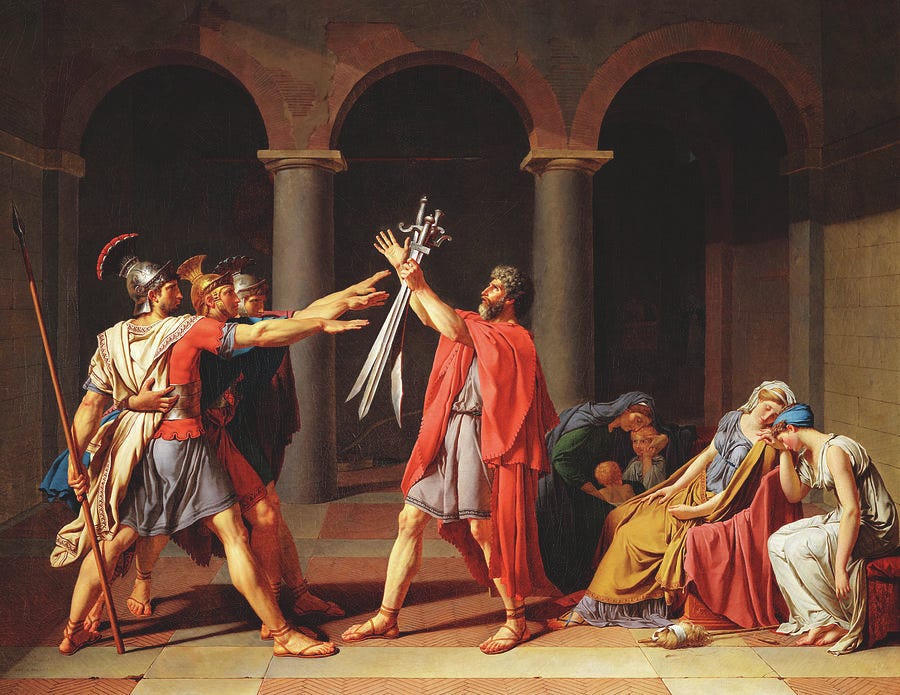
This essay is part one of a three-part exploration of Honor in my ongoing series on the Army Values. Honor is not simply one value among seven; it is the integrating value that makes the others coherent. Before we can understand the demands honor places on soldiers, or how it protects them from moral injury, we must recover what the word originally meant and why it shaped warrior cultures for thousands of years. This first installment examines the foundations of honor in the ancient world and why modern men feel its disappearance so acutely.
Honor is a word that lingers in the American vocabulary like the fading echo of a language we once spoke fluently. Young men today hear it in movie speeches or military recruiting videos, but seldom anywhere else. Their lives contain almost nothing that would teach them what honor is, much less how to live it. They sense instinctively that the world has become thinner, cheaper, and more chaotic, and that the older generations possessed something, some kind of backbone or clarity or standard, that men today were never handed.
That missing thing is not courage, or discipline, or patriotism. It is the structure that made those traits possible.
It is honor.
And American men live in a world that has forgotten what honor was, what it meant, and why it mattered.
Honor is not nostalgia. It is not costume. It is not the romanticized virtue of aristocrats or soldiers or dead civilizations. Honor was once the most important behavioral control system in human society. For thousands of years, it was the architecture through which men learned who they were, what was expected of them, and how to regulate their emotions, their impulses, their strength, and their responsibilities.
Modern society offers almost nothing that replaces it. And many men feel that loss in their bones.
This article is meant to give them an avenue back, not by preaching, not by moralizing, but by revealing what honor actually was across Greek, Roman, and Western military tradition, why it emerged, why it disappeared, and why the Army’s definition, “Live up to all the Army Values”, is the modern descendant of a much older and deeper inheritance. More importantly, it shows why honor is the antidote to moral injury, drift, and the crisis of identity so many men face today.
To begin that journey, we must start with the word itself, because in the ancient world, words carried weight, and honor carried more weight than most.
The Roots of Honor: A Word With a World Inside It
The English word honor comes from the Latin honor or honos, a term that blended esteem, public recognition, and the conferring of public office. In Rome, honor was not an internal feeling or a personal boast, it was something bestowed. A man did not simply claim honor; he was honored. It was given to him by others as a form of trust. This is why the Romans used the same word for both moral esteem and official position: an honor was literally an office granted because a man had already proven himself. To be “honored” was to be elevated into responsibility. Even today we still echo this original meaning when we “honor” someone with an award, or speak of a judge as “Your Honor,” or refer to a “guest of honor.” All of these uses preserve the ancient idea that honor is external recognition of internal reliability. It is civic gravity, the moral weight that draws trust toward a man because others believe he will fulfill his obligations even when no one is watching (Harris, 2010). Honor in this older sense was never self-ascribed. It was proof of service, conferred by the community as both reward and responsibility.
This is the part modern men often miss. We live in a culture that treats a person’s inner emotions, their private impulses, shifting preferences, their supposed “authenticity”, as if they were the highest form of truth. Modern authenticity means announcing whatever you feel in the moment and expecting the world to applaud. It is a child’s definition of identity, the belief that emotional expression is the same thing as moral worth. But nothing could be further from the honor systems that built civilizations. In the ancient world, a person was measured by what they did, not what they felt. Honor existed only in relationship. It was what others witnessed in you: your reliability, your composure, your courage, your loyalty when things got hard. Because others depended on those traits, they were the only traits that mattered. A man who could not regulate himself was not “inauthentic”, he was unreliable. And unreliability in a harsh world is fatal. No army, no tribe, no team can function under the modern idea that feelings come first. The ancients dismissed that thinking as childish because it is. Honor demanded mastery, not expression. It demanded that a man subordinate the chaos inside him to the standards of the group. Identity came from discipline, values, and action, not from broadcasting emotion. Where modern society celebrates inward-looking fragility, the ancient world celebrated outward-facing reliability. Honor was adulthood. Authenticity, in the modern sense, is adolescence disguised as a virtue.
Modernity tries to build character without that relational scaffolding and then wonders why young men feel like drifters. Honor was the world’s original stabilizing force. It was the system that made masculinity manageable, dangerous when necessary, but dependable the rest of the time. Men today long for that structure without knowing its name.
When the word passed from Latin to Old French, and then into English, it retained this relational quality. Honor was never only internal. Honor meant living in a way that preserved one’s standing within a moral community. To be honorable was to be trustworthy; to lose honor was to lose place.
Even the etymology carries this truth: honor was never just about moral purity, it was about belonging. A man lived honorably because without honor, he lost himself and his place in society.
The Greek Inheritance: The First Architecture of the Warrior’s Soul
If Rome gave honor its administrative spine, Greece gave it its emotional and psychological depth. Greek honor begins with time, public esteem. In Homeric society, identity was inseparable from reputation. A warrior was what other warriors saw him to be. His courage, his loyalty, his steadiness in danger, these were not private matters. They were the currency of social survival.
To modern ears, Achilles’ resentment at having his honor slighted may sound petulant. But in the world of the Iliad, honor was not a matter of ego, it was the structure that held the coalition together. A man whose honor was denied him had no standing. He was not simply offended; he was rendered less-than-full within the community of warriors (Bowman, 2006).
Greek warfare makes this logic obvious. A hoplite fought shoulder-to-shoulder, shield overlapping shield, his safety and the safety of his brothers dependent on mutual predictability. If one man panicked, the line buckled. Shame served as a social immune system. It kept fear from spreading and prevented the behaviors that could doom everyone (Hanson, 1999) in the same way that it did in armies advancing against enemy fire two thousand years later. The Greeks did not shame men to humiliate them. They shamed them to make the formation survive.
But Greek thought did not remain stuck in this reputation-based world. Over centuries, Greek philosophers deepened honor into something more interior. They believed that aretē, excellence, depended on the mastery of one’s passions. Courage, temperance, and self-command were the marks of a man fit to govern himself and to be trusted by others.
Greek honor thus developed a dual structure: the external esteem that made coalition warfare possible, and the internal discipline that made a warrior reliable without constant supervision.
Modern men are constantly told to “be their authentic selves,” but Greek men were taught to be their mastered selves. It is no wonder modern men feel adrift. A self without mastery has no center.
The Greeks understood what most men today feel but cannot articulate:
A man becomes a man when he learns to govern his impulses, especially under fear, anger, and humiliation.
That was honor’s first architecture.
The Roman Refinement: The Discipline of Men Trusted With Power
If the Greeks framed honor around courage and self-mastery, the Romans framed it around responsibility. The Roman Republic understood something fundamental about human beings: men with weapons, ambition, and charisma are inherently dangerous unless bound by a system that channels their power toward a higher purpose.
Roman honor did this better than any civilization before it.
Roman dignitas was the earned gravity of a man who had served faithfully and was recognized as reliable. Gravitas meant seriousness, a steadiness of temperament that made one capable of bearing public trust. Roman virtus, from the root vir meaning "man" so literally “manliness”, meant not spontaneous bravery but courage disciplined by reason and civic obligation (Harris, 2010). These were not abstract ideals. They were prerequisites for command.
A Roman leader was expected to control his emotions because men would die if he did not. He was expected to restrain his ambition because the Republic depended on officers who would not exploit their authority. He was expected to project steadiness because the legion’s cohesion rested on his bearing.
This is why Rome survived civil wars, invasions, and political upheavals long after other states would have collapsed. It possessed an honor system that disciplined the powerful. A Roman officer who lost honor lost his claim to authority.
Modern men grow up in a world of leadership without gravitas, often authority without accountability, and freedom without obligation. Little wonder they feel something missing. Roman honor gave men a framework for becoming worthy of trust. Modern culture gives men little more than slogans about self-esteem.
Honor is what makes a man able to carry weight.
The Gentleman-Officer: The Last Western Honor System
The fusion of Greek mastery and Roman duty found its last full expression in the nineteenth-century gentleman-officer. This was the final inherited honor system of the West before modernity stripped the concept of its structural power.
The gentleman’s honor was a code of whole-life conduct. It governed how a man bore himself in public, how he spoke, how he treated inferiors, how he restrained his appetites, how he accepted responsibility, and how he endured both praise and humiliation. It was the idea that a man of honor must be internally governed so that he could be trusted with external authority (Bowman, 2006).
This was not softness. Politeness was a training system for self-control. Dignified bearing was rehearsal for holding command. Restraint was preparation for making decisions under fire. In the old officer class, manners were not decorative, they were discipline.
Young men today rarely encounter this. They grow up without mentors, without rites of passage, without male-only spaces where a boy is turned into a man by older men, with no demand for gentlemanly conduct. They inherit no clear script for adulthood. They know they should be strong, but they do not know what strength is for. They sense they should have courage, but no one teaches them how to direct it. They hunger for leadership, but have no model of responsibility tethered to restraint.
The gentleman-officer ideal resonates today because it gave men a role. It told them what a man is supposed to be, ferocious in danger, restrained in power, faithful in obligation, and responsible in conduct. It gave them a standard.
Modern culture offers nothing comparable.
Honor as Behavioral Control Technology: The Hidden Machinery
Anthropologists like Pitt-Rivers (1977) and modern analysts like Bowman (2006) point out a truth that often surprises people raised in sentimental cultures: honor is not primarily a moral ideal. It is an ancient technology for regulating human behavior.
It evolved for one reason: to make dangerous men predictable.
Before the existence of modern states, early societies lacked the administrative machinery to enforce discipline. They could not monitor warriors on the battlefield. They could not track loyalty, prevent betrayal, or ensure emotional steadiness through external means.
So they internalized the enforcement mechanism.
Honor became the internal policeman.
A man policed himself because losing honor meant losing standing, opportunity, belonging, and identity. In an honor culture, a man’s sense of self is inseparable from how his peers judge him. Cowardice, betrayal, and unreliability are not simply dishonorable, they are forms of self-destruction.
This is why honor cultures are almost universally male. Men evolved in competitive coalitions. Male identity is tied to status, reliability, and recognition by other men. When honor is strong, men regulate themselves. When honor collapses, men become unpredictable, impulsive, and dangerous, to others and to themselves.
Modern psychology confirms this. The neural circuits for belonging, pride, shame, and fear are intertwined. When belonging is strong, men withstand hardship. When belonging is weak, men become fragile (Lende, 2012). Honor harnesses this architecture and turns it into discipline.
Honor is not virtue.
Honor is the infrastructure that makes virtue possible.
Shame: The Necessary Cost of Maintaining Honor
Shame is the price of honor, and modern society’s refusal to understand this is one of the reasons young men are adrift. Contemporary culture sees shame as inherently toxic, something to be avoided entirely. But for most of human history, shame was the moral feedback system that kept men from destroying themselves or others.
There is a difference between shame that attacks identity and shame that corrects behavior. Honor cultures rely on the latter, the shame that says, “You are capable of more. Do not fall beneath your standard.” This shame does not humiliate; it calibrates.
In warrior societies, shame prevented the behavior that would shatter the coalition, panic in formation, betrayal of comrades, abandonment of duty. Because identity was public, shame mattered. It kept fear from becoming flight, ambition from becoming treachery, and ego from becoming chaos.
Modern men rarely experience this healthy form of shame. They experience only two extremes: a world that refuses to judge anything, or a world that judges everything publicly without mercy. Honor gives a third path: a standard that corrects without destroying.
Men hunger for that correction. They long for a world where expectations make them better rather than smaller. Honor gives men the structure to climb upward.
Courage Norms: How Honor Standardizes the Warrior’s Response to Fear
Fear is the universal enemy of order. In combat, fear is not merely an emotion; it is a contagion. One man flinching can cause an entire formation to collapse. Honor cultures solve this by making courage the expected, default behavior, not because warriors feel fearless, but because the group depends on controlled action.
Bowman (2006) emphasizes that in honor cultures, courage is not primarily internal. It is relational. It is the performance the group requires from each man so that the group does not shatter. The warrior holds the line because the shame of failing to do so is worse than fear itself.
This is not repression. It is training.
Fear remains, but behavior remains steady.
Modern men often misunderstand courage because they frame it as a psychological state rather than a disciplined action. They wait to “feel brave.” Honor cultures teach men to act brave, because courage is a duty, not a mood.
This standardization of courage created armies capable of extraordinary feats, Greek phalanxes, Roman legions, and later the disciplined officer corps of the West. It created the emotional predictability without which no warrior profession can exist.
Young men today still hunger for this. They want something to steel them, to give their courage a form. Honor provides that form.
Loyalty: The Foundation of Warrior Brotherhood and the Antidote to Isolation
One of honor’s most important functions is preventing defection. In any society, the men most capable of harm are those entrusted with weapons and mobility. A warrior culture cannot survive if its members are unreliable.
Honor makes loyalty not optional but constitutive of identity. To be a warrior is to be loyal to one’s brothers. Betrayal is not merely immoral; it is unthinkable within the honor framework.
This is why betrayal wounds men more deeply than physical injury. It fractures the relational world that honor constructs. Modern men live in a society with weak bonds, friendships based on convenience, communities built on entertainment, and institutions that no longer command trust.
Honor restores the conditions for brotherhood. It gives men shared expectations, shared identity, and shared responsibility.
The ancient world understood what psychology shows today:
Men become stable, formidable, and disciplined not through isolation but through loyalty to a few trusted others.
Modern men may feel alone, but what they crave is the same thing Greek warriors and Roman legionaries had: a brother to their left and right, and a code that binds them together.
The Modern Decline of Honor, and Why Men Feel Lost
James Bowman argues that the decline of honor in the West did not create an amoral society; it created a psychologized society (Bowman, 2006). Honor was displaced not by vice, but by the therapeutic worldview. Where honor once governed male behavior through external expectation and internal discipline, psychology now governs through self-expression and emotion.
This shift has produced several consequences.
First, the disappearance of rites of passage means boys become legal adults without ever being turned into men. No one initiates them. No one tests them. No one teaches them how to carry their strength, or their anger, or their fear.
Second, men are told that restraint is repression, that composure is unhealthy, and that emotional discipline is pathology. This leaves them without any mechanism for managing the very forces that honor once shaped.
Third, society has eliminated almost all male-only spaces, the very environments where honor was traditionally taught, enforced, and transmitted from older men to younger ones. These settings once served as the forge where boys were shaped into men by mentors who understood the pressures of male life: competition, risk, responsibility, courage, restraint, and the demand for reliability. Today, not only have those spaces disappeared, but boys now grow up and are educated almost entirely in environments run by women. From preschool through university, the overwhelming majority of teachers, counselors, and administrators are female. This is not a criticism of women, it is simply an acknowledgment that women, by nature and by training, tend to emphasize emotional expression, safety, and relational harmony over the competitive rigor and behavioral discipline that male honor cultures require. Boys are shaped for fifteen years by institutions that reward compliance and self-expression rather than courage and self-command. They are taught to express their feelings rather than master their impulses. They are corrected for traits, assertiveness, competitiveness, risk-taking, that male honor cultures once cultivated as virtues. By the time they reach adulthood, many young men have spent their entire formative lives without meaningful exposure to honorable older men or to the expectations that once defined masculine development. They are left to form identity alone, with no mentors, no initiation, no feedback, and no code. A society that raises boys this way should not be surprised when they become men who feel lost and fail to fulfil their obligations.
Fourth, modern institutions often punish honorable behavior. Restraint is mocked. Discipline is misunderstood. Loyalty is viewed with suspicion. Men who attempt to live by an older code discover that society no longer knows how to read those signals.
The result is a kind of civilizational vertigo. Men feel disoriented because the world around them has removed the architecture that once shaped their identity. They long for something, structure, brotherhood, responsibility, mastery, that modern culture has forgotten how to give.
This is why honor must return, not as nostalgia, but as medicine.
The Army’s Definition: Honor as Alignment
The Army defines honor as “living up to all the Army Values” (Department of the Army, 2019). On the surface it appears almost too simple. But simplicity is not shallowness. The definition reflects thousands of years of moral architecture.
Honor is the integrating value, the value that gives coherence to all the others.
Honor is alignment.
Alignment between belief and behavior.
Between oath and action.
Between responsibility and authority.
Between the warrior’s public identity and private conscience.
This alignment prevents the internal fracture that later becomes moral injury. A soldier who lies to himself, who betrays a subordinate, who violates his oath, who acts against the laws of war, he fragments internally. His soul splits. His story stops making sense to him.
But a soldier who maintains alignment remains whole, even under immense pressure. He may suffer grief, loss, or trauma, but he will not lose himself.
Honor is what holds the self together.
What Honor Must Mean for the Modern Soldier, and the Modern Man
Honor must return, not as a costume or a slogan, but as a lived identity. The modern world cannot function without it. The profession of arms cannot function without it. And men cannot build meaningful lives without it.
Honor must once again become the architecture of manhood: the discipline that shapes emotion, the restraint that shapes aggression, the responsibility that shapes leadership, and the alignment that shapes the self.
Men do not thrive in freedom alone. They thrive in responsibility. They thrive in relationships of mutual trust. They thrive when their strength is bound to purpose. They thrive when they belong to a code that demands something difficult of them.
Honor demands difficulty.
It demands courage.
It demands self-mastery.
It demands responsibility.
It demands alignment.
But in return, honor gives a man something modern society cannot provide:
a way of life that makes sense.
Honor restores him to himself.
It gives him a place.
It gives him a standard.
It gives him the possibility of becoming whole in a world that fragments everything.
Honor is not the past.
Honor is the path forward.
References
Bowman, J. (2006). Honor: A history. Encounter Books.
Department of the Army. (2019). ADP 6-22: Army Leadership and the Profession. Headquarters, Department of the Army.
Hanson, V. D. (1999). The Western way of war: Infantry battle in classical Greece. University of California Press.
Harris, W. V. (2010). Roman power: A thousand years of empire. Cambridge University Press.
Litz, B. T., Stein, N., Delaney, E., Lebowitz, L., Nash, W. P., Silva, C., & Maguen, S. (2009). Moral injury and moral repair in war veterans: A preliminary model and intervention strategy. Clinical Psychology Review, 29(8), 695–706.
Pitt-Rivers, J. (1977). The fate of Shechem or the politics of sex: Essays in the anthropology of the Mediterranean. Cambridge University Press.
Lende, D. H. (2012). Honor, dignity, and victory: Understanding motivations for war. In A. H. McDonald (Ed.), The anthropology of war (pp. 72–92). Oxford University Press.
And in that way forward we have material quite ready to be ruthless and this should be leveraged.
Thank you, wonderful article.
Interesting timing - I've just been reading on how Freud has been outed as a fraud, and how people like Oliver Sacks lied to make better narratives in his literary career rather than actually help his patients. Had either man had honor in this sense, those things wouldn't have happened. A psychologized society is no improvement.
I'm curious how you would compare and contrast with an honor culture that causes men to murder their own daughters for perceived slights, such as not wearing headgear or falling in love with "non-believers?"